
The Voice Recognition Revolution Isn’t About You Talking to Your Phone
We’ve been sold a lie about voice technology. For a decade, the narrative has been simple: talk to your device, and it obeys. We were promised a frictionless utopia. Instead, we got smart speakers that misunderstand movie titles and in-car systems that dial the wrong contact. The real revolution isn’t about you talking to a machine. It is about the machines talking to each other, and cutting you out of the loop entirely.
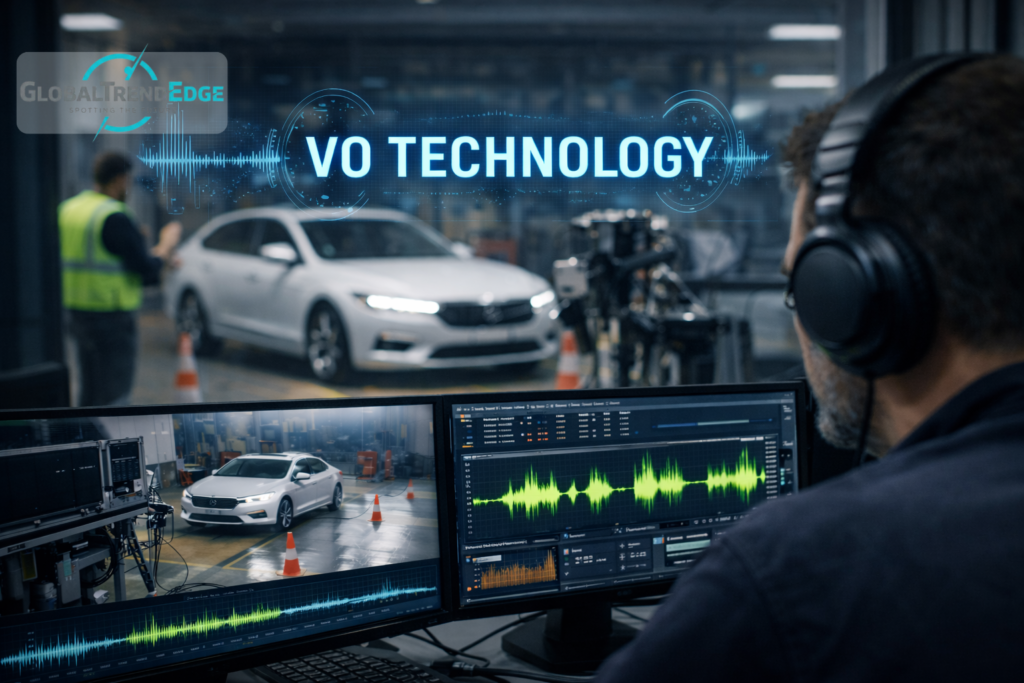
My “aha” moment happened in a noisy automotive lab, not a keynote hall. I was watching a prototype vehicle navigate a complex urban environment. The engineer next to me wasn’t giving driving commands. He was listening. The car’s internal voice system was analyzing the engine’s harmonic distortion and the tire resonance frequency. It “heard” a potential drivetrain failure 500 miles before it would happen. That is when I realized we are looking at the wrong end of the microphone.
The Shift from “Speech-to-Text” to “Acoustic Analytics”
The first major technical shift is the hardest for marketing teams to sell, so they simply don’t talk about it. We are moving away from Natural Language Processing (NLP) and diving headfirst into Acoustic Scene Analysis.
Why does this matter? Because your voice is just one sound in a sea of data. The new generation of VO technology isn’t just parsing syntax; it is analyzing the physics of sound waves. Micro-electromechanical systems (MEMS) are now sensitive enough to detect the minute vibrations of a rotating bearing or the air pressure changes in a sealed HVAC duct.
These systems use edge computing to process this data locally. They aren’t waiting for the cloud to tell them what a “clunk” sounds like. They compare the waveform signature against a library of mechanical failures in real-time. It’s predictive maintenance hidden inside a microphone. (Which, let’s be honest, is a much smarter use of the hardware than asking it to set a timer for pizza rolls.)
The Death of the “Wake Word” and the Rise of Passive Inference
Amazon and Google spent billions training us to say “Hey” and “Okay” to robots. It felt unnatural because it is unnatural. The next iteration of VO technology kills the wake word. It doesn’t need you to announce yourself.
This is driven by a shift in semiconductor architecture. We are seeing dedicated “Neural Processing Units” (NPUs) within audio codecs that run constantly on milliwatts of power. They are always listening, but they aren’t recording. They are looking for “events of interest.”
The system learns your behavioral patterns. It doesn’t need you to say, “I’m home.” It hears the specific jingle of your keys, the weight of your footsteps, and the cadence of your breathing as you climb the stairs. It cross-references this with your calendar location data. It infers you are home and adjusts the environment.
The future of UI is zero UI. You don’t interact with it. It just adapts. (Unless you snore. Then it definitely has to talk to the bed frame to adjust the angle.)
Synthetic Voice Fingerprinting and the Security Paradox
Here is where it gets ethically tricky. The technical leap in “voice biometrics” is staggering. We have moved beyond simple voice prints to “synthetic voice fingerprinting.” Algorithms can now analyze the unique sub-harmonics created by the physical dimensions of your vocal tract. It’s more secure than a retina scan in theory.
But here is the technical reality that keeps security architects up at night: Synthetic audio is now indistinguishable from real audio.
We are creating a paradox. The same Generative Adversarial Networks (GANs) used to train our authentication models to recognize your voice are being used by bad actors to clone it. We are in an arms race where the VO technology is fighting a mirror image of itself. Banks are rolling out voice ID, but the systems are struggling to differentiate between a live human and a deepfake replay attack that injects specific subsonic liveness cues.
What the Sales Reps Won’t Tell You
They won’t tell you about the “cocktail party problem” 2.0. The hardware is amazing at isolating a single voice in a crowd. What it still sucks at is emotional context.
The sales pitch is “seamless omnipresent assistance.” The hidden cost is ambient anxiety. When your environment is constantly listening and inferring, there is no “off” switch. The machine doesn’t need a wake word, so you never know when it’s in “inference mode.”
Furthermore, the maintenance cost is astronomical. Training these acoustic models for every single environment is a data-labeling nightmare. You can’t just train a model in a quiet studio and ship it. You have to train it for the rain in Seattle, the dry air of Arizona, and the echo of a glass-walled office. The models degrade over time as the physical hardware (the MEMS microphones) get clogged with dust or corrode. They won’t tell you that the “AI” is only as good as the last calibration cycle. And most users never calibrate anything.
The TL;DR Conclusion
Voice technology is finally growing up. It is leaving the gimmicky phase of playing your favorite song and entering the critical phase of infrastructure monitoring and behavioral prediction. The tech is moving from reactive (you talk) to passive inference (it listens) to proactive (it fixes). We get better predictive maintenance and frictionless security. We lose the illusion of privacy. It just works. Until the deepfake calls your bank.