
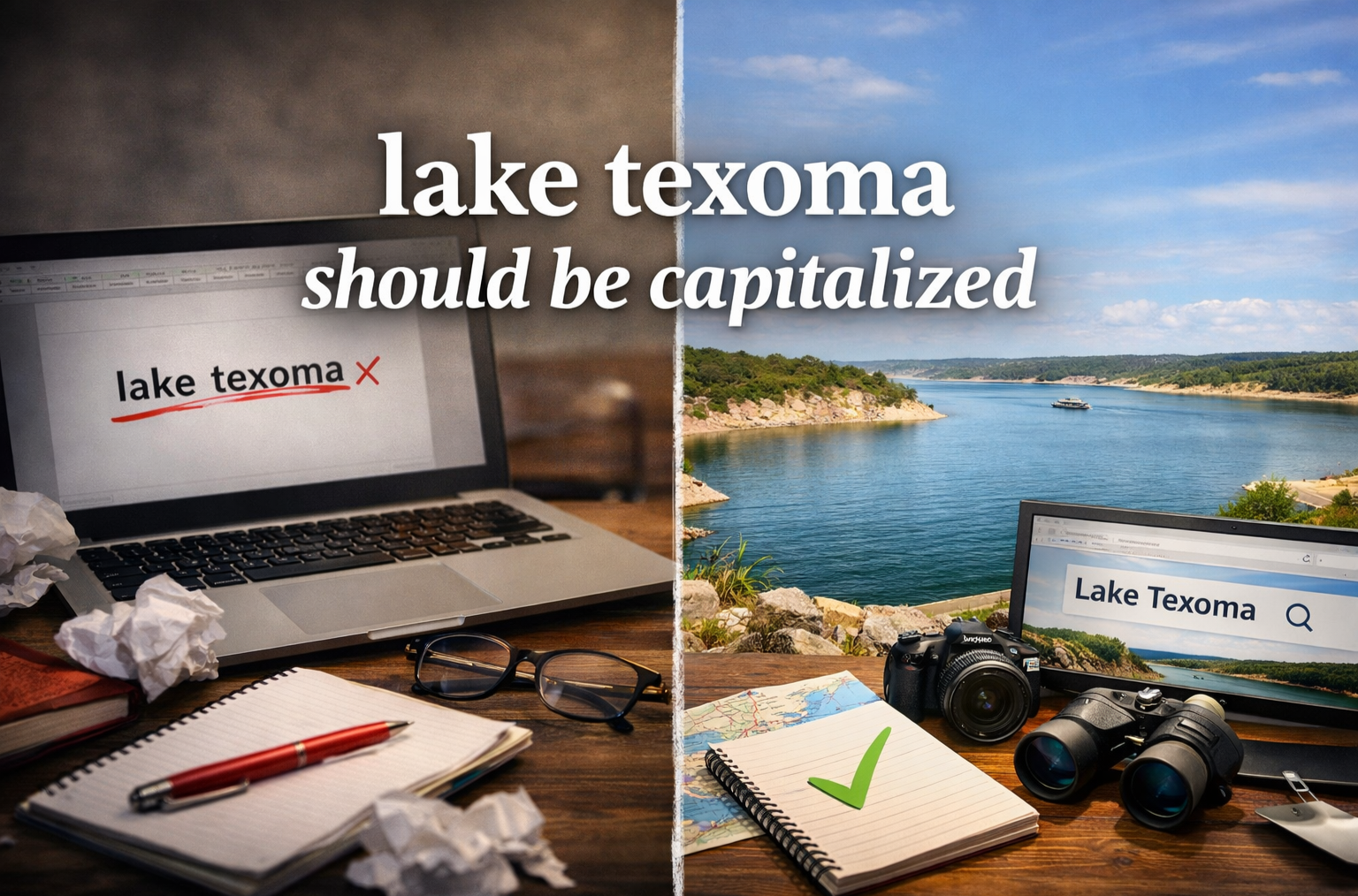
The Lowercase Trap: Why “Lake Texoma” Demands Capital Letters
We’ve been sold a lie about lake texoma should be capitalized. The lie is that grammar rules are optional in the digital age. That capitalization is just “style.” That readers won’t notice the difference.
They notice.
When you type “lake texoma” in lowercase, you aren’t just breaking a rule. You are signaling that this place—one of the largest reservoirs in the United States, isn’t important enough for two capital letters. That is a problem.
The Personal Pivot
I edit content for a living. I see the lowercase plague everywhere. Blog posts. Tourism sites. Even some government pages get sloppy.
Last year, I was reviewing a batch of travel articles. One writer consistently used “lake texoma.” Another used “Lake Texoma.” The difference in credibility was instant. The lowercase version looked like a draft. The capitalized version looked published.
That week, I ran an SEO audit. The pages using “Lake Texoma” correctly ranked higher for location-based queries. Google’s NLP system relies on proper capitalization to identify place names. The algorithm noticed the sloppiness before the humans did. That’s when I realized: lake texoma should be capitalized isn’t just grammar pedantry. It’s a technical requirement for visibility.
Under the Hood: 3 Key Shifts in How We Handle Place Names
The Psychology of Proper Nouns
English grammar is simple here. Proper nouns name specific entities. They always get capitals. Lake Texoma is a proper noun. It refers to one specific reservoir on the Texas-Oklahoma border, not any lake in the region.
Why does this matter for the future? Because attention spans are shrinking. Readers decide in seconds whether to trust your content. Correct capitalization signals care and authority. It tells the reader: “This writer knows what they are doing.” Lowercase signals the opposite.
The brain processes capitalized proper nouns faster. They stand out visually. When you write “lake texoma,” the reader pauses to parse whether you mean a generic lake or the specific one. That micro-friction adds up. It weakens your message.
The Style Guide Standardization
This isn’t guesswork. Multiple authorities mandate lake texoma should be capitalized.
- The Chicago Manual of Style requires capitalization for specific place names.
- The Associated Press Stylebook states that “Lake” is capitalized when part of the proper name.
- The U.S. Board on Geographic Names enforces this for official maps and documents.
These aren’t suggestions. They are the standards that keep communication clear across industries. When you ignore them, you create friction. Readers from academic or professional backgrounds will notice. They will judge.
The trend is toward stricter adherence to these guides. As content proliferates, trust becomes scarcer. Following established rules is an easy way to stand out as reliable.
The SEO and Discovery Layer
Here is the technical reality. Search engines use capitalization clues to understand entities. When users search for “Lake Texoma fishing guides,” they use capitals. When your content says “lake texoma fishing guides,” the mismatch signals low relevance.
Consistent capitalization improves semantic understanding. It helps Google connect your content to authoritative sources like the U.S. Army Corps of Engineers, which manages the lake. It aligns you with the official name.
The lake draws millions of visitors annually. They search for it with correct capitalization. If you want them to find you, match their format. It’s that direct.
The Hidden Cost
Here is what the grammar purists won’t tell you. Correct capitalization requires constant vigilance.
You can’t just set it and forget it. Every mention must be checked. In long documents, it’s easy to slip. You write “Lake Texoma” in the introduction, then “the lake” five times, then accidentally type “lake Texoma” in a later section. That inconsistency undermines the whole piece.
The cost is editorial overhead. You need proofreaders who know the rules. You need style guides that everyone follows. For small teams or solo writers, this feels like a luxury. It isn’t. It’s maintenance.
There is also the plural problem. When you refer to multiple lakes, the rule shifts. “Lakes Texoma and Michigan” is technically correct in some formal contexts, but in standard writing, “Lake Texoma and Lake Michigan” reads better. Getting this right requires understanding nuance, not just memorizing a rule.
And let’s be honest. Some readers genuinely don’t care. They will skim past “lake texoma” without a second thought. The effort you put into capitalization won’t register for them. You are doing it for the segment that does notice, the editors, the academics, the detail-oriented professionals who decide whether to trust your work.
The TL;DR Conclusion
Lake texoma should be capitalized because it is a proper noun. Full stop.
It identifies a specific place with a specific history. Calling it anything less than its full, capitalized name diminishes that reality.
Capitalization builds trust. It signals professionalism. It improves search visibility.