
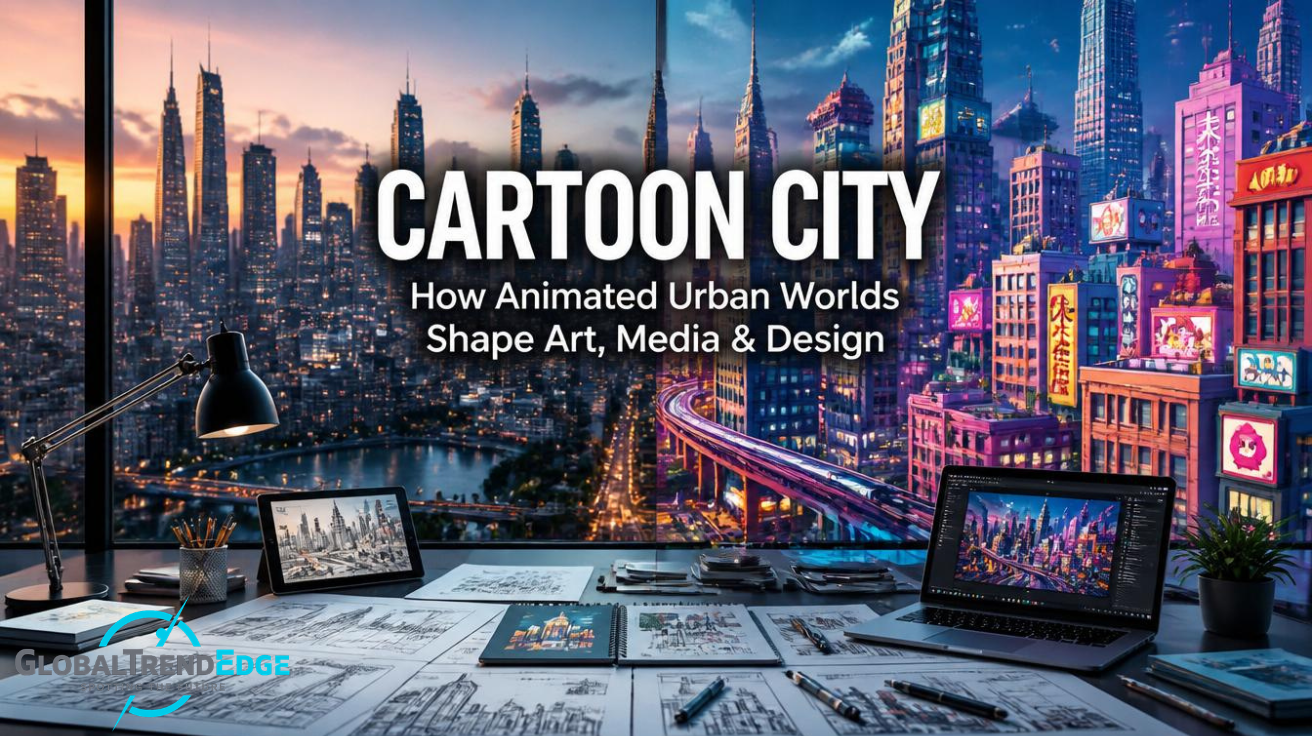
Cartoon City: A Complete Guide to Animated Urban Worlds in Art, Media, and Design
What Is a Cartoon City?
A cartoon city is more than a drawn backdrop. It is a world that tells a story before a single character speaks.
The term refers to any stylized, illustrated, or animated depiction of an urban environment. The style can range from simple flat art with bold outlines to richly detailed painterly scenes. What defines it is not the level of complexity but the deliberate departure from photorealism.
Cartoon cities appear in many forms. They show up as the setting for animated TV shows and films. They appear in video games, graphic novels, children’s books, murals, digital wallpapers, and concept art portfolios.
Why the Animated City Feels So Familiar
Urban environments are where most people live. Streets, buildings, traffic lights, and windows are part of everyday visual memory. When an artist stylizes that familiar world into clean shapes and bold colors, the city becomes both recognizable and fantastical at the same time.
A Brief History of the Animated City in Media
Cartoon cities have been part of storytelling for almost as long as animation itself. The way artists have designed them has shifted with technology, culture, and the stories being told.
1930s and 1940s – The Early Cartoon Backdrop
Early Fleischer Studios Superman shorts featured exaggerated Metropolis-style skylines. Buildings were tall, angular, and ominous. The city was a stage set designed for atmosphere rather than geographic accuracy.
1960s – The Jetsons and Utopian Futurism
Hanna-Barbera’s The Jetsons gave the world a cartoon city of cloud-level towers, moving walkways, and bubble-shaped architecture. It reflected the era’s optimism about technology and urban living.
1990s – The Golden Age of Animated Urban Settings
This decade produced some of the most iconic cartoon cities ever created. Batman: The Animated Series used a deco-influenced Gotham built from shadows and expressionist architecture. Hey Arnold! depicted a working-class urban neighborhood with affection for city life.
2000s to 2010s – Digital Tools Expand the Possibilities
As digital animation became standard, artists built more visually complex urban worlds. Futurama, Archer, and The Incredibles each created cities with distinctive visual identities.
2020s – The Global Artist Community
Digital art platforms have made cartoon cityscape illustration one of the most shared art styles in the world. Lofi aesthetic art, which often features cartoon city windows and night scenes, has reached enormous audiences.
Famous Cartoon Cities in Film and Television
Certain animated urban settings have become deeply embedded in popular culture. They are remembered not just as places where stories happened but as characters in their own right.
Gotham City – Batman: The Animated Series (1992)
The production team led by Bruce Timm and Eric Radomski designed Gotham as a city out of time. It draws from 1940s architecture lit with neon and patrolled by cars from different eras. The result is one of the most artistically distinctive cartoon cities ever put on television.
Townsville – The Powerpuff Girls (1998)
Craig McCracken’s Townsville was deliberately simple and cheerful. Its flat, clean shapes and bright colors became a touchstone for modern flat design illustration.
Springfield – The Simpsons (1989–Present)
Springfield is intentionally vague in its geography, but its visual design is instantly recognizable. Its suburban grid, the nuclear plant, Moe’s Tavern, and the elementary school form a cartoon urban shorthand understood worldwide.
New New York – Futurama (1999)
New New York was built on top of the ruins of present-day New York. The vertical layering of history into the urban landscape gave the city a specific comic depth.
San Fransokyo – Big Hero 6 (2014)
Disney’s concept team merged San Francisco’s hilly Victorian streetscape with Tokyo’s neon density. San Fransokyo has become one of animation’s most celebrated fictional cities.
Common Art Styles Used in Cartoon City Illustration
Understanding the visual vocabulary of different cartoon city styles helps artists make more intentional choices in their work.
| Style | Key Characteristics | Where You See It |
|---|---|---|
| Flat Design | Minimal shading, solid colours, geometric shapes, clean outlines | App icons, editorial illustration, brand identity |
| Isometric Art | 3D effect without perspective distortion, grid-based layout | Game design, infographics, concept art |
| Lofi Aesthetic | Warm muted tones, rain or night scenes, cosy urban windows | Study streams, playlists, wallpapers |
| Pixel Art | Grid-based, limited palettes, retro game visual language | Indie games, fan art, digital stickers |
| Noir / Gothic | High contrast, dark palettes, expressionist shadow play | Comic books, superhero animation |
| Studio Ghibli Style | Painterly detail, natural light, lived-in textures | Animation and game environments |
| Retrofuturist | Pastel palette, rounded architecture, flying vehicles | Retro fan art and themed illustration |
How to Draw a Cartoon City
Drawing a cartoon city from scratch can feel overwhelming. Urban environments have hundreds of elements. The key is to simplify deliberately rather than randomly.
Start With a Strong Silhouette
Before adding detail, sketch the outline of your skyline as a solid shape. A strong silhouette communicates the personality of the city at a glance.
Establish Your Light Source Early
Even in flat cartoon styles, deciding where your light comes from changes everything. Setting this early prevents inconsistency later.
Use Repetition Purposefully
Real cities repeat visual elements constantly. Windows, doors, fire escapes, and rooftop structures recur block after block.
Choose a limited color palette.
Restrict your color choices to three to five colors used consistently.
Layer Your Depth
Foreground elements should be darker and more detailed. Background elements should be lighter and simpler.
Add Human Scale
A tiny person on a sidewalk instantly tells viewers how large the buildings are.
Cartoon Cities in Lofi Music and Digital Culture
One of the most visible forms of cartoon city art in recent years is the lofi aesthetic.
The visual language is distinctive: a rain-wet street at night, warm light spilling from apartment windows, a single figure reading at a desk, a cat on a window ledge, and neon signs reflected in puddles. These images create a feeling of productive solitude inside a living urban world.
Why the Night City Image Resonates
The appeal of a cartoon night city is partly about contrast and partly about comfort. Being inside looking out at a dark rainy street is a familiar image of warmth and shelter.
Best Tools and Software for Cartoon City Art
If you want to create cartoon city illustrations yourself, here is an overview of popular tools used by artists.
Procreate
A popular choice for artists working on iPads. Its brush engine and layer management suit city illustration workflows.
Adobe Illustrator
Preferred by designers who want precise, scalable vector artwork.
Clip Studio Paint
Widely used by artists from manga and comics backgrounds. Its perspective ruler tools are useful for architectural illustration.
Aseprite
A standard choice for pixel art city illustration and animation.
Blender
Many concept artists block out a three-dimensional city layout in Blender before painting over it.
AI Art Tools
AI image generators can create cartoon city concepts from text prompts and are often used for brainstorming and reference generation.
Cartoon Cities in Video Games
Game design has produced some of the most memorable cartoon urban environments in any medium.
Games like Cities: Skylines have active fan communities creating cartoon-style asset packs. Mini Metro reduces a city to its transit network as abstract colored lines. Platformers including Cuphead and Rayman have built cartoon city levels that function as intricate artworks.
Why Cartoon Cities Matter Culturally
Cartoon cities carry cultural weight. They shape how children and adults imagine urban futures.
The retrofuturist cities of mid-century animation influenced ideas about future urban living, while darker animated cities reflected concerns about crime, technology, and social change.
Representation in Animated Urban Spaces
There has been growing attention to whose stories get told in cartoon cities. Hey Arnold! chose a working-class urban setting with a diverse cast, while newer animated series continue to explore different community experiences through urban storytelling.
Key Takeaways
- A cartoon city is any stylized or illustrated urban environment.
- The genre has existed since the early days of animation.
- Gotham City, Springfield, San Fransokyo, and New New York are among the most influential examples.
- Popular styles include flat design, isometric art, pixel art, lofi aesthetics, noir, and retrofuturism.
- Artists benefit from strong silhouettes, clear lighting, repetition, and limited color palettes.
- Lofi culture has helped make cartoon city imagery one of the most recognizable visual styles online.
- Video games, digital art platforms, and AI tools have expanded the possibilities of cartoon city art.
Frequently Asked Questions About Cartoon City
What is the most famous cartoon city ever created?
Gotham City from Batman: The Animated Series is often cited for artistic influence, while Springfield from
is among the most recognizable cartoon cities in the world.
How do I start drawing a cartoon city as a beginner?
Start with basic shapes and a simple skyline silhouette. Divide the skyline into buildings and add details gradually while maintaining a consistent light source.
What software is best for cartoon city illustration?
Procreate is popular for iPad users, Adobe Illustrator is widely used for vector art, and Aseprite is a leading option for pixel art.
What is the lofi cartoon city aesthetic?
It refers to cartoon city imagery commonly associated with study music and lofi content, often featuring night scenes, rain, warm window lights, and anime-inspired visuals.
Can AI generate good cartoon city images?
Yes. AI tools can create impressive cartoon city concepts and references, although artists often refine the results for consistency and detail.
What is isometric cartoon city art?
Isometric art represents three-dimensional environments using parallel projection, creating depth without traditional perspective distortion.
Conclusion
Cartoon cities occupy an important position in visual culture. They appear in films, games, wallpapers, streaming content, and digital design.
As digital art tools become more accessible, more artists are creating cartoon cityscapes than ever before. These illustrated urban worlds are not just backgrounds. They help shape how people imagine cities, communities, and the future itself.




[…] What Is a Cartoon City? Animated Urban Art & Design […]
[…] What Is a Cartoon City? Animated Urban Art & Design […]