

The iRepair Hustle is Dead.
That’s the marketing fluff. I realized the truth watching a seasoned technician revive a water-logged iPhone 13. He wasn’t following a glossy manual. He was running a voltage trace on a schematic, hunting for a shorted capacitor the size of a grain of sand. The business isn’t about swapping screens anymore. It’s forensic engineering.
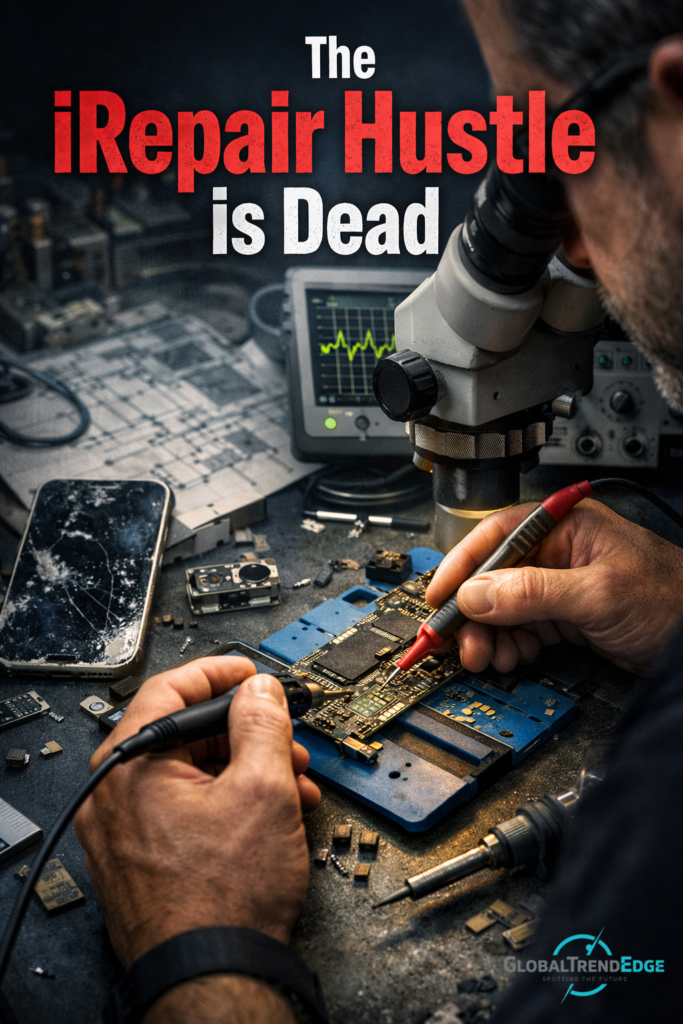
The Shift to Micro-Soldering & Board Repair
Screen and battery replacements are now commodities. The real skill is component-level repair. Modern smartphones are multi-board systems with dozens of tiny integrated circuits. A single failed power management IC can brick a device.
The future belongs to shops with rework stations and schematic access. This kills the “gig economy” repair model. You can’t train this in an hour.
The Commoditization of Modularity (It’s a Trap)
Manufacturers are finally making parts and guides available (looking at you, Apple Self Service Repair). This seems like a win. It’s a strategic pivot.
They’re selling you the modules at consumer-retail prices. Your local shop’s bulk pricing advantage evaporates. The profit margin gets baked upstream by the OEM. You become their logistics arm. (A clever one, frankly.)
The Data-First Repair Imperative
People don’t bring you a broken phone. They bring you their data. Their family photos, their 2FA authenticators, their business messages.
Successful repair shops now function as data recovery boutiques. The repair is the vehicle. The service is continuity. This requires a whole new suite of secure transfer tools and client trust protocols. It’s a different business.
What the Sales Reps Won’t Tell You
The software lock is now the primary point of failure. Part serialization and cloud-based pairing (via tools like Apple’s System Configuration) mean a perfect hardware fix can still result in a non-functional camera or Face ID. You are at the mercy of the manufacturer’s authorization servers. This isn’t a bug. It’s a business model.
Your “genuine” part is a roll of the dice. The aftermarket is flooded with pulled, refurbished, and cloned components. That “original” display could be a reject bin panel with a transferred serial number chip. You can’t always tell until you’ve installed it and get a warning message. The diagnostic burden is on you.
TL;DR: iRepair has industrialized.
It’s no longer a side hustle. Surviving requires capital for advanced tools, deep technical training for board work, and a pivot to data-as-a-service. The barrier to entry just got very, very high.