
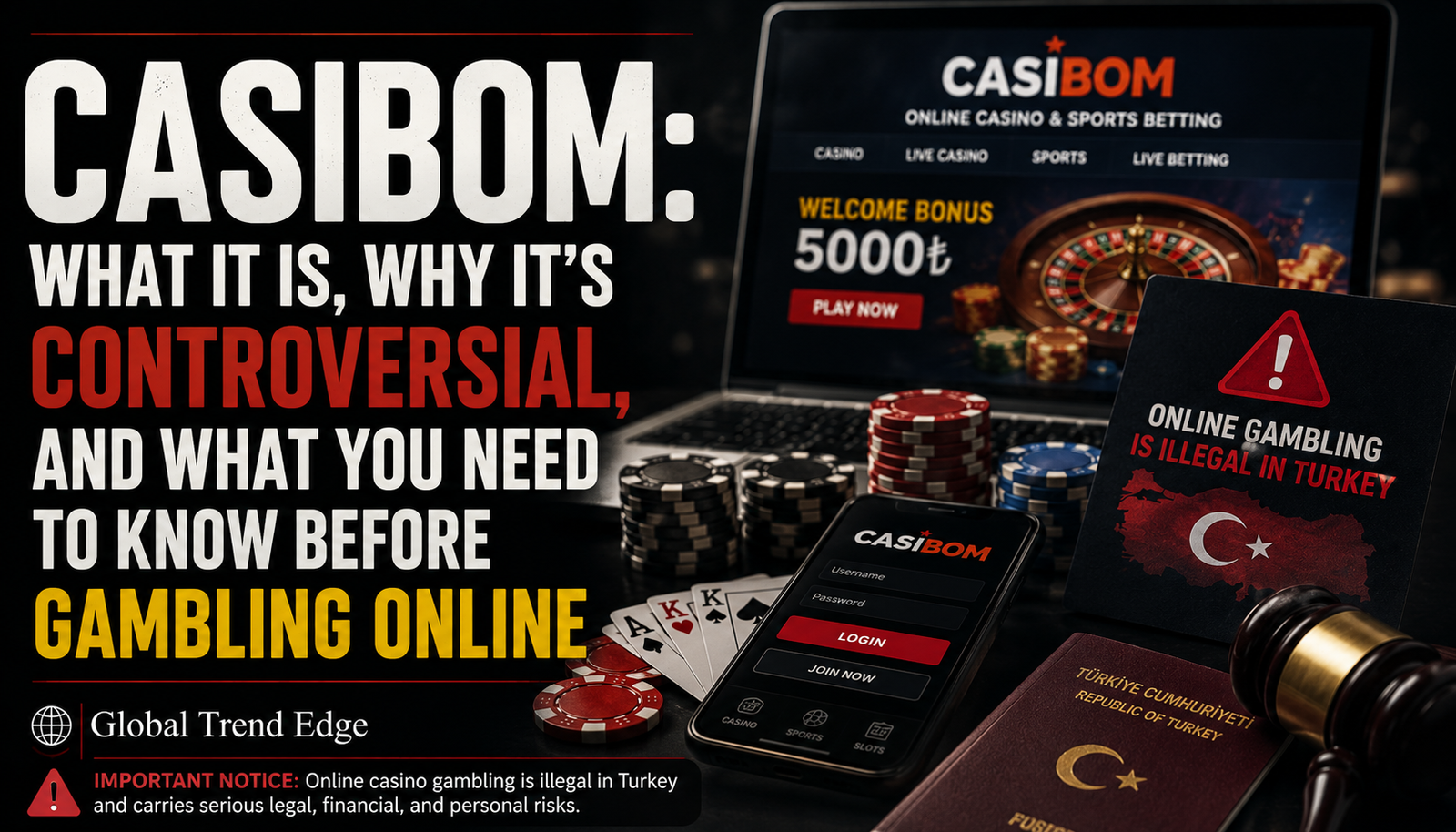
Casibom: What It Is, Why It’s Controversial, and What You Need to Know Before Gambling Online
Important Notice: This article is written to inform, not to promote. Online casino gambling is illegal in Turkey under national law. Using unlicensed gambling platforms carries genuine legal, financial, and personal risks. This guide explains those risks honestly so you can make an informed decision.
Introduction
When a website shows up repeatedly in search results without any clear, trustworthy information about it, that’s usually a sign that it needs scrutiny, not a sales pitch.
Casibom is one of those platforms. It markets itself as an online casino and sports betting destination, primarily targeting Turkish-speaking users. It has attracted a significant number of visitors and has been widely searched in Turkey. But behind the promotional language and flashy game libraries is a more complicated reality: this platform operates in a country where its core activities are against the law, without holding a verifiable license from any recognized gambling authority.
This article doesn’t exist to help Casibom acquire customers. It exists to answer the question people are actually asking: what is this site, is it safe, and what am I getting into if I use it?
What Is Casibom?
Casibom (sometimes written with alternate spellings or presented with different domain extensions) is an online gambling platform offering casino games, live dealer games, slot machines, sports betting, and live in-play betting. Its content is primarily in Turkish, and it is aimed squarely at the Turkish market.
The platform follows a pattern common among gambling sites that operate in restricted jurisdictions: it runs on a series of frequently rotating domain names. When one domain gets blocked by Turkish internet authorities, the site migrates to a new address. Users who follow the site often look for its current access link, which changes regularly.
This domain-hopping is not incidental to how the site operates, it is the site’s survival mechanism. It exists precisely because Turkish law prohibits what the platform does, and the rotation of domains is how it continues to function after government-mandated blocks.
The Legal Reality: Gambling Law in Turkey
Understanding Casibom requires understanding Turkey’s legal framework for gambling, because the two are directly connected.
What Turkish Law Actually Says
Turkey has one of the most restrictive gambling legal frameworks in Europe and the Middle East. The key points:
Casinos have been banned since 1998. This includes both physical casino venues and, since 2006, online casino operations. There is no licensing pathway for private companies to operate casino games in Turkey.
Online casino gambling is explicitly illegal. Under Article 228(3) of the Turkish Criminal Code, providing a venue or platform for gambling through information systems is a criminal offense. This applies to both operators and, in some contexts, players.
The only legal gambling options in Turkey are state-controlled: IDDAA (the government-authorized sports betting platform), the national lottery (Milli Piyango), and regulated horse race betting through the Turkish Jockey Club (TJK). These are the only services a private citizen can use legally.
Website blocking is actively enforced. Turkey’s Information and Communication Technologies Authority (BTK, known in Turkish as Bilgi Teknolojileri ve İletişim Kurumu) regularly issues blocking orders against illegal gambling websites. Thousands of gambling domains have been blocked under Law No. 5651.
Financial monitoring is increasing. Turkey’s Financial Crimes Investigation Board (MASAK) actively monitors banking transactions linked to illegal gambling activity. Deposits and withdrawals to and from unlicensed gambling sites can be flagged and frozen.
This is not an ambiguous legal gray area. Private online casino gambling in Turkey is prohibited, not merely unregulated.
What Makes Casibom Specifically Risky
Beyond the general legal issues, platforms like Casibom carry a specific set of risks that are worth understanding clearly.
No Recognized Gambling License
A gambling license from a credible authority, the UK Gambling Commission (UKGC), the Malta Gaming Authority (MGA), Gibraltar, or the Isle of Man, requires operators to meet strict standards: independently audited game fairness, segregated player funds, responsible gambling tools, dispute resolution procedures, and anti-money laundering compliance.
Casibom does not appear to hold a verifiable license from any major, internationally recognized regulatory body. Without that license, none of those protections apply to you as a player. The games could be rigged. Payouts could be refused. Your account could be closed without warning or explanation.
There is no regulator you can file a complaint with. There is no independent arbitration body that will hear your case. If the platform decides not to pay your winnings, you have no legal recourse.
Withdrawal Risks
One of the most consistent complaints reported about unlicensed casino platforms relates to withdrawals. Common patterns include:
- Accounts being “frozen” following a large win, pending “verification” that never completes
- Withdrawal requests being delayed indefinitely
- Accounts being closed for alleged “terms violations”, terms that are often vague and only cited when a payout becomes inconvenient for the operator
- Bonus conditions imposed retroactively to prevent cash-outs
Without regulatory oversight, there is nothing stopping an unlicensed operator from doing any of these things. Licensed casinos face heavy fines and license revocation for such behavior. Unlicensed ones face no equivalent consequences.
Data and Personal Security
To register on any gambling platform, you typically provide personal information: name, date of birth, address, email, phone number, and payment details. In some cases, identity documents are required.
Licensed operators are legally required to maintain data security standards, follow data protection laws (such as GDPR in Europe), and undergo regular technical audits. Unlicensed operators have no such obligation. Your personal data, including financial information, may be stored insecurely, sold to third parties, or exposed in breaches with no accountability.
No Responsible Gambling Protections
Regulated gambling platforms are required by law to offer responsible gambling tools: deposit limits, session time limits, self-exclusion options, reality checks, and links to support organizations. These exist because gambling addiction is a recognized public health concern.
Unlicensed platforms have no obligation to offer any of these tools. Many deliberately omit them because removing friction around spending is in their commercial interest. Players who develop gambling problems while using these platforms have no safety net, no self-exclusion register, no operator-required intervention, no legal protection.
Legal Exposure for Users
While enforcement against individual players in Turkey tends to focus more on operators than users, the law does not exempt players from all liability. The Petty Offenses Law (Kabahatler Kanunu) makes gambling itself an offense subject to administrative fines, with proceeds subject to confiscation. As financial monitoring becomes more sophisticated, the risk profile for individual users is not zero.
How Unlicensed Gambling Sites Operate: The Bigger Picture
Casibom is not unique. It is one of many sites following the same operational model in jurisdictions with gambling restrictions.
These platforms typically:
- Register companies in offshore jurisdictions with minimal oversight (or list no clear registration at all)
- Operate through cloud hosting providers that are difficult to locate or take down
- Change domain names as fast as authorities can block them
- Market through affiliate networks, social media influencers, and word-of-mouth in messaging apps
- Accept deposits through cryptocurrency, prepaid cards, or e-wallets that are harder to trace than bank transfers
- Make withdrawal more difficult than deposit, relying on the fact that many players will continue gambling rather than attempt a cashout
This model works because the friction between “what users want now” (entertainment, the possibility of winning) and “what might happen later” (blocked withdrawals, legal risk, data exposure) is largely invisible until something goes wrong.
What to Look for If You Choose to Gamble Online
For readers in countries where online gambling is legal and who want to engage with it responsibly, the difference between a safe and an unsafe platform comes down to a few verifiable factors.
Verify the License
Every legitimate gambling operator displays its license number prominently, usually in the website footer. You should be able to click that license number and be taken directly to the regulator’s public register, where the license is listed and verifiable.
The most credible licensing jurisdictions include:
- UK Gambling Commission (UKGC) – ukgc.gov.uk – widely regarded as the gold standard for player protection
- Malta Gaming Authority (MGA) – mga.org.mt – covers many European and international operators
- Gibraltar Regulatory Authority – gra.gi
- Isle of Man Gambling Supervision Commission – gov.im/gambling
Curaçao eGaming licenses (a common alternative) offer significantly weaker player protection than the above and should be evaluated carefully.
Check Independent Review and Blacklist Resources
Several independent watchdog organizations track casino operator behavior and maintain blacklists of problematic operators:
- AskGamblers (askgamblers.com) – player complaint resolution and casino ratings
- Casinomeister (casinomeister.com) – longstanding community-based casino watchdog
- ThePogg (thepogg.com) – independent dispute resolution service
A simple search of a casino’s name alongside “complaints,” “withdrawal issues,” or “scam” will often surface player reports if problems exist.
Look for Responsible Gambling Tools
Any licensed casino operating under a credible regulatory framework will offer self-exclusion, deposit limits, and links to support organizations. If a platform makes these hard to find or doesn’t offer them at all, that is a meaningful warning sign.
Verify Encryption and Payment Security
A legitimate casino uses HTTPS encryption (look for the padlock symbol in your browser address bar). Payment methods should include established processors, major credit cards, PayPal, and bank transfer, not exclusively cryptocurrency or prepaid vouchers, which are harder to dispute.
Responsible Gambling: Real Resources
If you or someone you know is struggling with gambling-related harm, these organizations provide confidential support:
Gamblers Anonymous – gamblersanonymous.org – is an international support network with meetings in many countries and an online presence for those who need discretion.
GamCare (UK) – gamcare.org.uk – Free confidential support and counseling for gambling problems. Helpline available 24/7.
BeGambleAware (UK) – begambleaware.org – Information, self-assessment tools, and referral to treatment services.
National Council on Problem Gambling (US) – ncpgambling.org – Helpline: 1-800-522-4700, available 24/7.
Gambling Therapy – gamblingtherapy.org, is a free global service offering online support, forums, and therapy for people affected by gambling problems.
If you are in Turkey and concerned about gambling harm, speak with a healthcare professional or contact a mental health support line. The Turkish Psychological Association (Türk Psikologlar Derneği) can assist in locating appropriate support resources.
Key Takeaways
- Casibom is an online casino and sports betting platform primarily targeting Turkish users through frequently rotating domain names.
- Online casino gambling is illegal in Turkey under national law and has been since 2006. Casibom operates in direct violation of Turkish gambling legislation.
- The platform does not appear to hold a license from any major, internationally recognized gambling regulatory authority.
- Without a verifiable license, players have no legal protection if games are unfair, withdrawals are refused, or personal data is misused.
- Turkey’s banking and financial regulators actively monitor transactions linked to illegal gambling activity, creating financial risk for users.
- The domain-rotation model that platforms like Casibom use is a direct consequence of, and response to, legal blocking by Turkish authorities.
- Responsible online gambling requires verifying a license from a credible authority, using established payment methods, and accessing platforms that offer responsible gambling tools.
- Gambling addiction is a recognized public health concern. Free, confidential support is available through multiple international organizations.
Frequently Asked Questions
What is Casibom?
Casibom is an online gambling platform offering casino games, slot machines, live dealer games, and sports betting. It primarily operates in Turkish and targets users in Turkey. It uses rotating domain names to stay accessible after government-mandated website blocks.
Is Casibom legal in Turkey?
No. Online casino gambling is illegal in Turkey under the Turkish Criminal Code and related legislation. Casibom operates without the authorization of Turkish gambling authorities. The only legal gambling services in Turkey are the state-operated IDDAA sports betting platform, the national lottery (Milli Piyango), and regulated horse racing.
Does Casibom have a gambling license?
Casibom does not appear to hold a verifiable license from any major international gambling regulatory authority such as the UKGC, Malta Gaming Authority, or Gibraltar Regulatory Authority. This absence of recognized licensing is a significant risk factor for players.
Why does Casibom change its domain address frequently?
Turkish authorities regularly issue blocking orders against illegal gambling websites through the BTK (Information and Communication Technologies Authority). Platforms like Casibom rotate their domain names to continue operating after each block. The need to do this is a direct result of being prohibited from operating legally in Turkey.
What happens if Turkish authorities catch someone using Casibom?
The legal risk varies. Primary enforcement targets operators rather than individual users. However, Turkish law does classify gambling as an offense under the Petty Offenses Law, and gambling proceeds are subject to confiscation. Increased financial monitoring by MASAK means that large gambling-related bank transactions are more likely to attract scrutiny than they were in the past.
Can I get my money back if Casibom refuses to pay?
Without a gaming license from a recognized authority, there is no regulatory body to file a complaint with and no legally enforceable dispute resolution mechanism. If an unlicensed operator refuses to process your withdrawal, your options are extremely limited. This is one of the most significant practical risks of using unregulated gambling platforms.
What are the safest alternatives for online gambling?
For users in countries where online gambling is legal, the safest options are platforms holding licenses from the UKGC, MGA, or similarly credible authorities. These regulators require independent game auditing, segregated player funds, responsible gambling tools, and formal complaints processes.
What are the signs that an online casino might be unsafe?
Key red flags include: no verifiable gambling license (or a license from a low-regulation jurisdiction), withdrawal conditions that are harder than deposit conditions, no responsible gambling tools, customer support that is unresponsive or unavailable, no HTTPS encryption, and a history of player complaints about non-payment on independent watchdog sites.
I think I have a gambling problem. Where can I get help?
Gamblers Anonymous (gamblersanonymous.org), GamCare (gamcare.org.uk), and Gambling Therapy (gamblingtherapy.org) offer free, confidential support in multiple languages. In the US, the National Problem Gambling Helpline is 1-800-522-4700, available 24/7. You don’t have to be certain you have a problem to reach out, these services exist for anyone who has concerns about their gambling.
Conclusion
Casibom is not a difficult platform to find. The challenge is finding honest, complete information about what it actually is rather than promotional content designed to make it look legitimate.
The facts are straightforward: it’s an online gambling platform operating without recognized licensing in a country where its activities are prohibited by law. Users who deposit money on the platform do so without the consumer protections that licensed gambling regulation exists to provide.
That doesn’t mean this article can stop anyone from using it. Adults make their own decisions. But those decisions deserve to be made with clear information, not in the absence of it. The risks covered here, legal exposure, withdrawal refusals, data security, and absence of responsible gambling tools, are real and documented, not hypothetical.
If you’re in Turkey and want to bet legally, IDDAA is the government-authorized option. If you’re in a country where online gambling is legal and you want to participate, a few minutes verifying a casino’s license on a regulator’s official website is a reasonable minimum step. And if gambling has become a problem rather than entertainment, the organizations listed above offer help without judgment.