

MTO Explained: What It Means, Who Uses It, and Why It Matters
Introduction
A three-letter acronym can mean entirely different things depending on who’s using it. Ask a supply chain manager what MTO means, and they’ll talk about production strategy. Ask an Ontario driver, and they’ll point you toward a government ministry. Ask someone scrolling through celebrity news, and they’ll mention a gossip website they check every morning.
“MTO” is genuinely one of those terms where context does all the heavy lifting. It appears in manufacturing textbooks, government forms, entertainment blogs, and everything in between. Rather than picking one definition and pretending the others don’t exist, this guide covers all the major interpretations, clearly, in plain language. so you can identify which one applies to your situation and understand it properly.
What Does MTO Stand For?
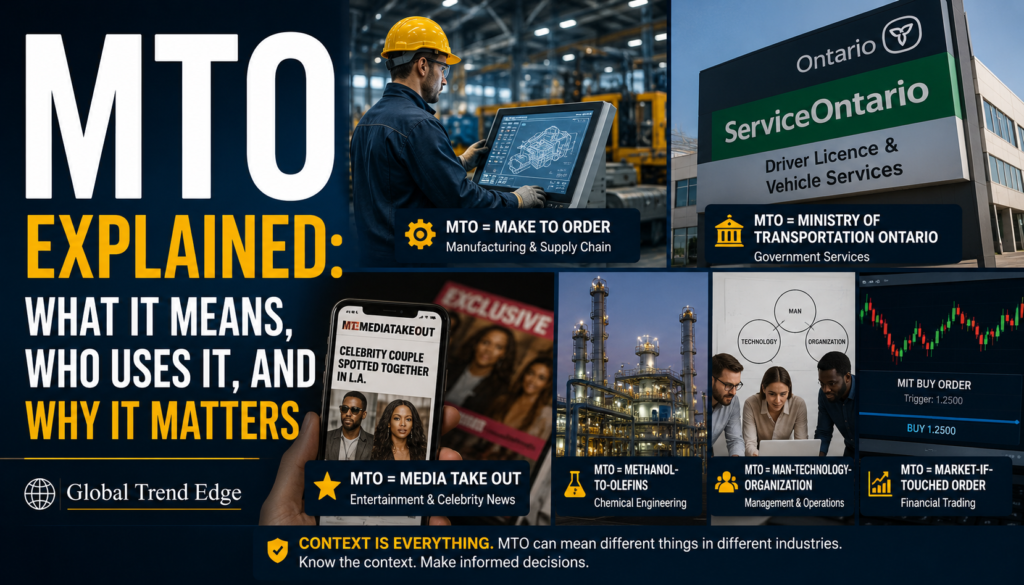
Here are the most widely recognized meanings of MTO, ranked by how commonly each one appears in everyday search and use:
| Meaning | Context |
|---|---|
| Make to Order | Manufacturing, supply chain, business operations |
| Ministry of Transportation Ontario | Canadian government, driver licensing, road infrastructure |
| Media Take Out | Entertainment, celebrity news, pop culture |
| Methanol-to-Olefins | Petrochemical engineering |
| Man-Technology-Organization | Industrial management framework |
| Market-if-Touched Order | Financial trading, brokerage platforms |
Each is covered below. The first three receive the most detailed treatment because they account for the vast majority of searches for this acronym.
MTO Meaning #1: Make to Order
What Is Make-to-Order?
<p>Make to Order (MTO) is a manufacturing production strategy in which a company only begins building a product after a confirmed customer order has been received. Nothing is made in advance and kept on shelves waiting for a buyer. Instead, the customer order acts as the trigger; everything from raw material sourcing to final assembly starts from that point. </p> <p> This is sometimes described as a “pull” supply chain model because demand from the customer pulls production into motion, rather than a company pushing products into inventory based on guesswork about what might sell. </p>
The concept has roots in the Just-in-Time (JIT) manufacturing philosophy, which emerged from Toyota’s production system in Japan and prioritizes building only what is needed, when it is needed. MTO takes that principle and applies it specifically to order-driven, often customized production.

How the MTO Process Works
The flow of a typical MTO production cycle looks like this:
Step 1 – Customer places an order. The customer specifies their exact requirements, dimensions, materials, configuration, and quantity.
Step 2 – Order triggers planning. The production team reviews specifications and creates a manufacturing plan tailored to that order.
Step 3 – Raw materials are procured. Because nothing was pre-purchased, materials are sourced specifically for this job.
Step 4 – Manufacturing begins. The product is built according to customer specifications.
Step 5 – Quality checks and dispatch. The finished product is inspected, packaged, and shipped.
There is minimal (sometimes zero) finished goods inventory at any stage. The product moves directly from production to the customer who ordered it.
MTO vs. MTS vs. ATO: What’s the Difference?
Understanding MTO is easier when you place it alongside the strategies it’s typically compared to.
Make to Stock (MTS) is the opposite of MTO. Products are manufactured in advance based on demand forecasts, then stored as inventory ready for immediate sale. Think of consumer goods like bottled water, packaged food, or standard office chairs; these are made before any individual order exists and are waiting on shelves when you buy them.
Assemble to Order (ATO) sits between the two. Core components or sub-assemblies are manufactured and stocked in advance, but final assembly only happens once an order arrives. A good example is a computer manufacturer that pre-builds motherboards, drives, and frames, but only assembles them into a complete unit based on what each customer configures.
Engineer to Order (ETO) is an even more intensive version of MTO. Not only is the product made to order, it’s also designed to order. Large infrastructure projects, custom industrial equipment, and specialized aerospace components often fall under ETO.
Here’s how they compare side by side:
| Strategy | Inventory Level | Lead Time | Customization | Example |
|---|---|---|---|---|
| MTO | Very low | Longer | High | Custom furniture, bespoke suits |
| MTS | High | Short (immediate) | Low | Packaged snacks, generic clothing |
| ATO | Moderate (parts only) | Medium | Moderate | Personal computers, modular kitchens |
| ETO | Minimal | Longest | Very high | Ships, custom aircraft, large bridges |
Advantages of Make-to-Order
Minimal waste and inventory costs. When you only make what someone has already paid for, you don’t end up with unsold goods taking up space. This is particularly valuable for expensive materials or products with short shelf lives.
Higher customization. MTO naturally accommodates unique specifications. A manufacturer doesn’t need to predict what customers want; the customer tells them directly.
Reduced financial risk. Every production run is tied to a confirmed sale. This removes the financial exposure that comes with mass-producing items that might not sell.
Better cash flow control. In many MTO arrangements, a deposit or advance payment is collected when the order is placed, which helps fund production rather than relying on borrowed capital or existing reserves.
Sustainability benefits. Producing only what’s needed reduces overproduction, which in turn reduces material waste, energy consumption, and carbon footprint, a growing concern for companies under environmental reporting pressure.
Disadvantages of Make-to-Order
Longer lead times. The most significant trade-off. Customers must wait for production to start and complete. For commodities where buyers expect immediate delivery, MTO simply doesn’t fit.
Unpredictable production schedules. Order volume can spike during peak seasons and drop during slow periods, making capacity planning and workforce management genuinely challenging.
Higher per-unit costs. Without the economies of scale that come from mass production, individual units often cost more to produce. Those costs are typically passed on to the customer, which means MTO products carry premium price tags.
Complex supply chain coordination. Sourcing materials for each unique order, sometimes from multiple suppliers, requires tighter logistics and more sophisticated planning systems.
No buffer stock. If something goes wrong during production (defective materials, equipment failure, or shipping delays), there’s no finished goods inventory to fall back on. This can leave customers waiting even longer.
Which Industries Use MTO?
Make-to-order manufacturing is widespread in sectors where customization, complexity, or unit cost makes mass production impractical:
Aerospace and defense. Commercial aircraft, military equipment, and satellites are engineered and built to very specific client requirements. No manufacturer pre-builds a jumbo jet and hopes someone buys it.
Industrial machinery. Custom production equipment, specialized CNC machines, and large-scale processing systems are built around the buyer’s exact specifications.
Construction and infrastructure. Steel structures, custom facades, prefabricated building components, and bridge components are typically designed and produced for specific projects.
Luxury goods and fashion. Bespoke suits, handmade shoes, custom watches, and made-to-measure garments represent the consumer-facing version of MTO. Heritage brands like Rolls-Royce (automotive), Steinway (pianos), and Savile Row tailors operate almost entirely on this model.
Medical devices. Prosthetics, custom implants, and specialized medical equipment are often produced to patient-specific measurements.
Furniture. High-end furniture manufacturers, kitchen cabinet makers, and commercial fit-out companies frequently work on made-to-order schedules.
Real-World MTO Examples
Boeing aircraft: Each commercial aircraft ordered by an airline is configured to that airline’s specifications, cabin layout, engine type, avionics packages, and paint scheme. Boeing doesn’t pre-build 737s and keep them in a lot, waiting for buyers.
Custom kitchen cabinetry: A homeowner selects dimensions, wood type, finish, and hardware. The manufacturer builds those exact units only after the signed order and deposit arrive.
Luxury watches: Brands like Patek Philippe and A. Lange & Söhne produce watches in very limited quantities, often to specific customer orders, particularly for complications or unique case configurations.
Industrial pumps: A chemical plant requiring a pump system for a specific fluid, temperature, and pressure specification orders one built to those exact parameters, something a catalog item couldn’t provide.
MTO in ERP and Software Systems
In enterprise software environments, SAP, Oracle, Microsoft Dynamics, and similar platforms, MTO has a specific technical meaning. It refers to a planning strategy within Materials Requirements Planning (MRP) where the system only generates production orders in response to confirmed sales orders. Components and materials are reserved for that specific order, tracked through production, and tied back to the customer.
SAP’s implementation, for example, uses individual/collective requirements indicators in the material master to designate whether a material follows MTO or MTS logic. This distinction drives procurement, scheduling, costing, and inventory management behavior throughout the system.
MTO Meaning #2: Ministry of Transportation Ontario
What Is the MTO?
The Ministry of Transportation (MTO) is a provincial government ministry of Ontario, Canada. It has been responsible for transportation policy, road infrastructure, and driver and vehicle services in the province since it was founded in 1916 as the Department of Public Highways of Ontario.
The MTO is headquartered in Toronto and operates under the Government of Ontario. It oversees one of Canada’s largest highway networks, approximately 16,900 kilometers of provincial highways, and administers the programs that keep drivers licensed and vehicles legally registered across the province.
For most Ontario residents, the MTO is the agency they deal with when they need a driver’s license, vehicle registration, license plates, or road safety information.
Key Services the MTO Provides
Driver Licensing. The MTO administers Ontario’s Graduated Licensing System (GLS), which new drivers must work through before obtaining a full G license. The system requires passing a written knowledge test, holding a G1 license for a minimum period, passing a road test to obtain a G2, and then a final road test for the full G license.
Vehicle Registration. All motor vehicles in Ontario must be registered with the MTO before being driven on public roads. Registration can be completed in person at ServiceOntario centers, online, or by phone. Ontario eliminated vehicle registration renewal fees for passenger vehicles in 2022, though annual renewal is still required.
License Plates. License plates are issued by the MTO, currently in the format ABCD-123, with the “Yours to Discover” slogan and a crown symbol. Plates issued after April 2020 are white rather than the previous blue design.
Road Conditions and Traffic Information. The MTO runs the province’s 511 traveler information system, which provides real-time road closures, construction updates, and traffic camera feeds. The 511 app and website display highway conditions across Ontario’s highway network.
Commercial Vehicle Oversight. The MTO regulates truck transport, oversees commercial vehicle inspection stations, enforces weight limits and hours of service rules for truck drivers, and manages the province’s CVOR (Commercial Vehicle Operator’s Registration) system.
Road Safety Programs. This includes distracted driving enforcement, impaired driving countermeasures, school zone rules, seatbelt legislation, and road design standards.
Transit and Infrastructure Funding. The MTO is involved in planning and funding major transit and highway projects across the province, working in partnership with municipalities, Metrolinx, and other agencies.
How to Access MTO Services
Most driver and vehicle services in Ontario are delivered through ServiceOntario, which acts as the service delivery arm on behalf of the MTO. You can access them:
- Online at ontario.ca, for license plate renewal, address changes, checking license status
- In person at any ServiceOntario location (found at serviceontario.ca)
- By phone through ServiceOntario’s automated service lines
The MTO’s own website (ontario.ca/page/ministry-transportation) provides detailed information on programs, policy updates, and highway work.
Graduated Licensing System (GLS) – A Closer Look
Ontario’s graduated licensing system is one of the MTO’s most frequently asked-about programs, especially for new drivers or newcomers to Ontario.
G1 License, entry level. Requires passing a written knowledge test on road signs and rules. G1 holders can drive only with a fully licensed driver (at least 4 years licensed) in the front seat. No highway driving alone, no driving between midnight and 5 AM.
G2 License – After 12 months of G1 (or 8 months with an approved driver education course), passing a road test earns a G2. G2 holders can drive alone, but there are restrictions on passengers, blood alcohol levels, and the number of passengers after midnight.
Full G License—After at least 12 months on a G2, a second road test earns the full G license with no restrictions. License renewal is required every 5 years.
Newcomers to Ontario with a license from another Canadian province or an eligible foreign country may be eligible for license exemptions or testing reductions. The MTO’s website details which licenses qualify.
MTO Meaning #3: Media Take Out (MTO News)
What Is MTO News?
Media Take Out, commonly called MTO or MTO News, is an American entertainment and celebrity gossip website. It was founded in January 2006 by Fred Mwangaguhunga, a former corporate lawyer from Queens, New York, who transitioned from law into digital media entrepreneurship after earlier ventures in the online space.
The platform is accessible at mediatakeout.com and publishes stories about celebrities, musicians, athletes, social media influencers, and entertainment industry developments. It has a particular focus on African American celebrities, hip-hop culture, and Black entertainment broadly, a niche that mainstream tabloids historically underserved.
How MTO News Started
Mwangaguhunga’s background was in corporate law. He moved into online business with a laundry service, which introduced him to the mechanics of web traffic and online advertising. After selling that venture, he applied those lessons to entertainment blogging.
The site grew quickly after launch. Within a few years, MediaTakeOut had established itself as one of the most-visited celebrity gossip destinations online, receiving millions of page visits per month and ranking among the top-visited entertainment sites globally. Its growth coincided with the rise of digital-first media and the decline of traditional print tabloids.
The site’s style, bold, fast, often sensational headlines, matched the energy of early social media. Stories from MTO frequently circulated on platforms like Twitter and Facebook, where viral content rewarded speed over deliberation.
What Kind of Content MTO News Publishes
MTO News covers celebrity relationships, breakups, and family drama; music industry news and feuds; exclusive photos and videos; reality television updates; and viral social media moments. The tone is direct, conversational, and culturally specific, written for readers who are deeply embedded in the worlds of hip-hop, R&B, and Black popular culture.
The site has been credited with breaking stories that mainstream outlets later picked up. Its network of insider sources and community tips gives it reach into entertainment circles that traditional newsrooms sometimes lack.
Reliability and How to Read MTO News
This is worth addressing honestly. Media Bias/Fact Check, an independent source credibility tracking organization, classifies MTO News (the associated outlet) as “Questionable” in terms of factual reporting accuracy, citing a history of publishing unverified claims, rumors, and occasionally fabricated stories without sufficient sourcing.
This doesn’t mean everything on the site is wrong; many of its exclusives have later proven accurate and have been confirmed by major networks. But the platform’s culture of speed means stories sometimes run before they’ve been fully verified.
For readers, the practical takeaway is simple: treat MTO News the way you’d treat any entertainment gossip source, as a place to catch the earliest version of a story, not necessarily the final or confirmed version. Cross-referencing major claims with established outlets like AP, Reuters, or Rolling Stone before fully accepting them is good practice.
MTO Meaning #4: Methanol to Olefins
In petrochemical engineering and the chemical industry, MTO refers to methanol to olefins, a catalytic process that converts methanol into light olefins, primarily ethylene and propylene. These olefins are fundamental feedstocks for plastics, packaging, and a wide range of industrial chemicals.
The process is significant because it offers a route to producing petrochemical feedstocks from coal or natural gas via methanol, rather than relying solely on crude oil-derived naphtha. It has seen considerable commercial deployment in China, where domestic coal resources make it economically attractive.
Technology providers in the MTO space include Honeywell UOP and Dalian Institute of Chemical Physics (DICP). This definition of MTO is highly specific to chemical engineering audiences and doesn’t overlap meaningfully with the other three uses of the acronym.
MTO Meaning #5: Man-Technology-Organization
In organizational management and ergonomics, MTO stands for Man-Technology-Organization (sometimes rendered as Human-Technology-Organization or HTO). It’s a systems framework that looks at how humans, the technology they work with, and the organizational structures around them interact to affect productivity, safety, and efficiency.
The framework is used in industries like aviation, nuclear power, offshore oil and gas, and complex manufacturing, where failures often arise from the breakdown of interaction between people, tools, and systems, not from any single factor in isolation.
MTO Meaning #6: Market-if-Touched Order
In financial trading, an MTO or MIT (Market-if-Touched) order is a type of conditional order instruction. It becomes a market order to buy or sell once a security touches a specified price level. It differs from a stop order in directionality: an MIT buy order is placed below the current market price, while a stop buy order is placed above it.
This use of MTO is broker-platform specific and not universally standard across all trading systems. Traders should verify their platform’s exact terminology and behavior before relying on it.
Key Takeaways
- MTO is a genuinely multi-meaning acronym, and context is everything when decoding it.
- In manufacturing and business, MTO (Make to Order) is a customer-driven production strategy where nothing is built until a confirmed order exists, reducing waste but extending lead times.
- MTO differs from MTS (Make to Stock) in that production is pulled by actual orders, not pushed by demand forecasts.
- In Ontario, Canada, the MTO (Ministry of Transportation Ontario) is the government body responsible for driver licensing, vehicle registration, highway infrastructure, and road safety programs.
- In entertainment, MTO News (MediaTakeOut) is a celebrity gossip website founded in 2006, primarily covering Black entertainment and hip-hop culture.
- Other technical meanings include Methanol to Olefins (chemical engineering) and Man-Technology-Organization (industrial management).
- When someone uses “MTO” without context, the most likely meaning depends entirely on their industry or situation.
Frequently Asked Questions
What does MTO stand for in business?
In business and manufacturing, MTO stands for “Make to Order,” a production strategy where manufacturing begins only after a confirmed customer order is received. It is the opposite of Make to Stock, where products are pre-built and held in inventory.
What is MTO in supply chain management?
In supply chain terms, MTO is a pull-based production model. The customer order triggers procurement, manufacturing, and fulfillment. It minimizes finished goods inventory and supports customization but results in longer delivery lead times than stock-based models.
What is the MTO in Ontario?
MTO in Ontario refers to the Ministry of Transportation, a provincial government ministry responsible for Ontario’s highway network, driver licensing (including the G1/G2/G license system), vehicle registration, license plates, road safety programs, and commercial vehicle regulation.
How do I contact the MTO in Ontario?
Most MTO services are accessible through ServiceOntario. You can visit a ServiceOntario location in person, go online at ontario.ca, or call ServiceOntario directly. The MTO’s official web presence is at ontario.ca/page/ministry-transportation.
What is MTO News?
MTO News, full name MediaTakeOut, is an American celebrity gossip website launched in 2006 by Fred Mwangaguhunga. It covers celebrity news with a focus on African American entertainers and hip-hop culture. It is a fast-publishing, blog-style entertainment platform with a large following.
Is MTO News reliable?
MTO News is primarily an entertainment and gossip platform. Some of its exclusives have proven accurate, but independent media watchdogs have flagged a pattern of unverified or partially sourced stories. It’s best treated as a first-look source that should be cross-checked with established news outlets for significant claims.
What is make-to-order vs. make-to-stock?
Make to Order (MTO) starts production after a customer places an order; there is little or no pre-built inventory. Make to Stock (MTS) produces goods in advance based on demand forecasts; products are ready for immediate purchase. MTO suits customized, complex, or expensive products. MTS suits high-volume, standardized goods where buyers expect immediate availability.
Which companies use MTO manufacturing?
Aerospace manufacturers (Boeing and Airbus), luxury vehicle makers (Rolls-Royce and Bentley), bespoke fashion brands, industrial machinery companies, custom furniture makers, and medical device manufacturers commonly use MTO strategies. The approach is prevalent anywhere product customization, complexity, or cost makes pre-production impractical.
What is Methanol-to-Olefins (MTO)?
In the chemical and petrochemical industries, MTO refers to a catalytic process that converts methanol into light olefins, particularly ethylene and propylene, which are used as feedstocks for plastics and other industrial chemicals. The process is most commercially active in China, where abundant coal is converted to methanol and then to olefins.
What is the G1/G2/G licensing system managed by the MTO?
Ontario’s Graduated Licensing System (GLS) is a three-stage licensing process administered by the MTO. New drivers start with a G1 (knowledge test only), progress to a G2 (first road test), and eventually obtain the full G license (second road test). Each stage has specific restrictions and minimum time requirements designed to build driving experience gradually.
Conclusion
MTO is one of those acronyms that tells you very little on its own. What it communicates depends entirely on who’s using it and where.
If you’re in manufacturing or operations, MTO is almost certainly about make-to-orde, a lean, demand-driven production philosophy that trades inventory costs for customization capability and longer lead times. It sits at the heart of how luxury goods, aerospace components, industrial equipment, and bespoke services are produced.
If you’re in Ontario, Canada, MTO is probably the Ministry of Transportation, the government body you deal with for your driver’s license, your license plates, your vehicle registration, and road safety information.
If you’re following celebrity and entertainment news, MTO likely means Media Take Out, the gossip website that’s been covering Black celebrity culture since 2006.
Knowing which MTO you’re dealing with avoids confusion. Each version has its own logic, its own processes, and its own relevance to the person asking. This guide has aimed to give each of them the honest, practical treatment they deserve.